∞∞∞∞∞∞∞
MAELZEL’S CHESS-PLAYER.
Perhaps no exhibition of the kind has ever elicited so general attention as the Chess-Player of Maelzel. Wherever seen it has been an object of intense curiosity, to all persons who think. Yet the question of its modus operandi is still undetermined. Nothing has been written on this topic which can be considered as decisive — and accordingly we find every where men of mechanical genius, of great general acuteness, and discriminative understanding, who make no scruple in pronouncing the Automaton a pure machine, unconnected with human agency in its movements, and consequently, beyond all comparison, the most astonishing of the inventions of mankind. And such it would undoubtedly be, were they right in their supposition. Assuming this hypothesis, it would be grossly absurd to compare with the Chess-Player, any similar thing of either modern or ancient days. Yet there have been many and wonderful automata. In Brewster's Letters on Natural Magic, we have an account of the most remarkable. Among these may be mentioned, as having beyond doubt existed, firstly, the coach invented by M. Camus for the amusement of Louis XIV when a child. A table, about four feet square, was introduced, into the room appropriated for the exhibition. Upon this table was placed a carriage, six inches in length, made of wood, and drawn [column 2:] by two horses of the same material. One window being down, a lady was seen on the back seat. A coachman held the reins on the box, and a footman and page were in their places behind. M. Camus now touched a spring; whereupon the coachman smacked his whip, and the horses proceeded in a natural manner, along the edge of the table, drawing after them the carriage. Having gone as far as possible in this direction, a sudden turn was made to the left, and the vehicle was driven at right angles to its former course, and still closely along the edge of the table. In this way the coach proceeded until it arrived opposite the chair of the young prince. It then stopped, the page descended and opened the door, the lady alighted, and presented a petition to her sovereign. She then re-entered. The page put up the steps, closed the door, and resumed his station. The coachman whipped his horses, and the carriage was driven back to its original position.
The magician of M. Maillardet is also worthy of notice. We copy the following account of it from the Letters before mentioned of Dr. B., who derived his information principally from the Edinburgh Encyclopædia.
“One of the most popular pieces of mechanism which we have seen, is the Magician constructed by M. Maillardet, for the purpose of answering certain given questions. A figure, dressed like a magician, appears seated at the bottom of a wall, holding a wand in one hand, and a book in the other. A number of questions, ready prepared, are inscribed on oval medallions, and the spectator takes any of these he chooses, and to which he wishes an answer, and having placed it in a drawer ready to receive it, the drawer shuts with a spring till the answer is returned. The magician then arises from his seat, bows his head, describes circles with his wand, and consulting the book as if in deep thought, he lifts it towards his face. Having thus appeared to ponder over the proposed question, he raises his wand, and striking with it the wall above his head, two folding doors fly open, and display an appropriate answer to the question. The doors again close, the magician resumes his original position, and the drawer opens to return the medallion. There are twenty of these medallions, all containing different questions, to which the magician returns the most suitable and striking answers. The medallions are thin plates of brass, of an elliptical form, exactly resembling each other. Some of the medallions have a question inscribed on each side, both of which the magician answered in succession. If the drawer is shut without a medallion being put into it, the magician rises, consults his book, shakes his head, and resumes his seat. The folding doors remain shut, and the drawer is returned empty. If two medallions are put into the drawer together, an answer is returned only to the lower one. When the machinery is wound up, the movements continue about an hour, during which time about fifty questions may be answered. The inventor stated that the means by which the different medallions acted upon the machinery, so as to produce the proper answers to the questions which they contained, were extremely simple.”
The duck of Vaucanson was still more remarkable. It was of the size of life, and so perfect an imitation of the living animal that all the spectators were deceived. It executed, says Brewster, all the natural movements [page 319:] and gestures, it eat [[ate]] and drank with avidity, performed all the quick motions of the head and throat which are peculiar to the duck, and like it muddled the water which it drank with its bill. It produced also the sound of quacking in the most natural manner. In the anatomical structure the artist exhibited the highest skill. Every bone in the real duck had its representative in the automaton, and its wings were anatomically exact. Every cavity, apophysis, and curvature was imitated, and each bone executed its proper movements. When corn was thrown down before it, the duck stretched out its neck to pick it up, swallowed, and digested it.*
But if these machines were ingenious, what shall we think of the calculating machine of Mr. Babbage? What shall we think of an engine of wood and metal which can not only compute astronomical and navigation tables to any given extent, but render the exactitude of its operations mathematically certain through its power of correcting its possible errors? What shall we think of a machine which can not only accomplish all this, but actually print off its elaborate results, when obtained, without the slightest intervention of the intellect of man? It will, perhaps, be said, in reply, that a machine such as we have described is altogether above comparison with the Chess-Player of Maelzel. By no means — it is altogether beneath it — that is to say provided we assume (what should never for a moment be assumed) that the Chess-Player is a pure machine, and performs its operations without any immediate human agency. Arithmetical or algebraical calculations are, from their very nature, fixed and determinate. Certain data being given, certain results necessarily and inevitably follow. These results have dependence upon nothing, and are influenced by nothing but the data originally given. And the question to be solved proceeds, or should proceed, to its final determination, by a succession of unerring steps liable to no change, and subject to no modification. This being the case, we can without difficulty conceive the possibility of so arranging a piece of mechanism, that upon starting it in accordance with the data of the question to be solved, it should continue its movements regularly, progressively, and undeviatingly towards the required solution, since these movements, however complex, are never imagined to be otherwise than finite and determinate. But the case is widely different with the Chess-Player. With him there is no determinate progression. No one move in chess necessarily follows upon any one other. From no particular disposition of the men at one period of a game can we predicate their disposition at a different period. Let us place the first move in a game of chess, in juxta-position with the data of an algebraical question, and their great difference will be immediately perceived. From the latter — from the data — the second step of the question, dependent thereupon, inevitably follows. It is modelled by the data. It must be thus and not otherwise. But from the first move in the game of chess no especial second move follows of necessity. In the algebraical question, as it proceeds towards solution, the certainty of its operations remains altogether unimpaired. The second step having been a consequence of the data, the [column 2:] third step is equally a consequence of the second, the fourth of the third, the fifth of the fourth, and so on, and not possibly otherwise, to the end. But in proportion to the progress made in a game of chess, is the uncertainty of each ensuing move. A few moves having been made, no step is certain. Different spectators of the game would advise different moves. All is then dependent upon the variable judgment of the players. Now even granting (what should not be granted) that the movements of the Automaton Chess-Player were in themselves determinate, they would be necessarily interrupted and disarranged by the indeterminate will of his antagonist. There is then no analogy whatever between the operations of the Chess-Player, and those of the calculating machine of Mr. Babbage, and if we choose to call the former a pure machine we must be prepared to admit that it is, beyond all comparison, the most wonderful of the inventions of mankind. Its original projector, however, Baron Kempelen, had no scruple in declaring it to be a “very ordinary piece of mechanism — a bagatelle whose effects appeared so marvellous only from the boldness of the conception, and the fortunate choice of the methods adopted for promoting the illusion.” But it is needless to dwell upon this point. It is quite certain that the operations of the Automaton are regulated by mind, and by nothing else. Indeed this matter is susceptible of a mathematical demonstration, a priori. The only question then is of the manner in which human agency is brought to bear. Before entering upon this subject it would be as well to give a brief history and description of the Chess-Player for the benefit of such of our readers as may never have had an opportunity of witnessing Mr. Maelzel's exhibition.
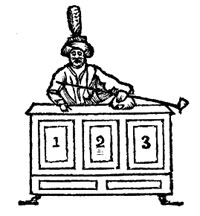
The Automaton Chess-Player was invented in 1769, by Baron Kempelen, a nobleman of Presburg in Hungary, who afterwards disposed of it, together with the secret of its operations, to its present possessor. Soon after its completion it was exhibited in Presburg, Paris, Vienna, and other continental cities. In 1783 and 1784, it was taken to London by Mr. Maelzel. Of late years it has visited the principal towns in the United States. Wherever seen, the most intense curiosity was excited by its appearance, and numerous have been the attempts, by men of all classes, to fathom the mystery of its evolutions. The cut above gives a tolerable representation of the figure as seen by the citizens of Richmond a few weeks ago. The right arm, however, should lie more at length upon the box, a chess-board should appear upon it, and the cushion should not be seen while the pipe is held. Some immaterial alterations have been made in the costume of the player since it came into the possession of Maelzel — the plume, for example, was not originally worn. [page 320:]
At the hour appointed for exhibition, a curtain is withdrawn, or folding doors are thrown open, and the machine rolled to within about twelve feet of the nearest of the spectators, between whom and it (the machine) a rope is stretched. A figure is seen habited as a Turk, and seated, with its legs crossed, at a large box apparently of maple wood, which serves it as a table. The exhibiter will, if requested, roll the machine to any portion of the room, suffer it to remain altogether on any designated spot, or even shift its location repeatedly during the progress of a game. The bottom of the box is elevated considerably above the floor by means of the castors or brazen rollers on which it moves, a clear view of the surface immediately beneath the Automaton being thus afforded to the spectators. The chair on which the figure sits is affixed permanently to the box. On the top of this latter is a chess-board, also permanently affixed. The right arm of the Chess-Player is extended at full length before him, at right angles with his body, and lying, in an apparently careless position, by the side of the board. The back of the hand is upwards. The board itself is eighteen inches square. The left arm of the figure is bent at the elbow, and in the left hand is a pipe. A green drapery conceals the back of the Turk, and falls partially over the front of both shoulders. To judge from the external appearance of the box, it is divided into five compartments — three cupboards of equal dimensions, and two drawers occupying that portion of the chest lying beneath the cupboards. The foregoing observations apply to the appearance of the Automaton upon its first introduction into the presence of the spectators.
Maelzel now informs the company that he will disclose to their view the mechanism of the machine. Taking from his pocket a bunch of keys he unlocks with one of them, door marked 1 in the cut above, and throws the cupboard fully open to the inspection of all present. Its whole interior is apparently filled with wheels, pinions, levers, and other machinery, crowded very closely together, so that the eye can penetrate but a little distance into the mass. Leaving this door open to its full extent, he goes now round to the back of the box, and raising the drapery of the figure, opens another door situated precisely in the rear of the one first opened. Holding a lighted candle at this door, and shifting the position of the whole machine repeatedly at the same time, a bright light is thrown entirely through the cupboard, which is now clearly seen to be full, completely full, of machinery. The spectators being satisfied of this fact, Maelzel closes the back door, locks it, takes the key from the lock, lets fall the drapery of the figure, and comes round to the front. The door marked 1, it will be remembered, is still open. The exhibiter now proceeds to open the drawer which lies beneath the cupboards at the bottom of the box — for although there are apparently two drawers, there is really only one — the two handles and two key holes being intended merely for ornament. Having opened this drawer to its full extent, a small cushion, and a set of chessmen, fixed in a frame work made to support them perpendicularly, are discovered. Leaving this drawer, as well as cupboard No. 1 open, Maelzel now unlocks door No. 2, and door No. 3, which are discovered to be folding doors, opening into one and the same compartment. To the right of this compartment, [column 2:] however, (that is to say the spectators’ right) a small division, six inches wide, and filled with machinery, is partitioned off. The main compartment itself (in speaking of that portion of the box visible upon opening doors 2 and 3, we shall always call it the main compartment) is lined with dark cloth and contains no machinery whatever beyond two pieces of steel, quadrant-shaped, and situated one in each of the rear top corners of the compartment. A small protuberance about eight inches square, and also covered with dark cloth, lies on the floor of the compartment near the rear corner on the spectators’ left hand. Leaving doors No. 2 and No. 3 open as well as the drawer, and door No. 1, the exhibiter now goes round to the back of the main compartment, and, unlocking another door there, displays clearly all the interior of the main compartment, by introducing a candle behind it and within it. The whole box being thus apparently disclosed to the scrutiny of the company, Maelzel, still leaving the doors and drawer open, rolls the Automaton entirely round, and exposes the back of the Turk by lifting up the drapery. A door about ten inches square is thrown open in the loins of the figure, and a smaller one also in the left thigh. The interior of the figure, as seen through these apertures, appears to be crowded with machinery. In general, every spectator is now thoroughly satisfied of having beheld and completely scrutinized, at one and the same time, every individual portion of the Automaton, and the idea of any person being concealed in the interior, during so complete an exhibition of that interior, if ever entertained, is immediately dismissed as preposterous in the extreme.
M. Maelzel, having rolled the machine back into its original position, now informs the company that the Automaton will play a game of chess with any one disposed to encounter him. This challenge being accepted, a small table is prepared for the antagonist, and placed close by the rope, but on the spectators’ side of it, and so situated as not to prevent the company from obtaining a full view of the Automaton. From a drawer in this table is taken a set of chess-men, and Maelzel arranges them generally, but not always, with his own hands, on the chess[[-]]board, which consists merely of the usual number of squares painted upon the table. The antagonist having taken his seat, the exhibiter approaches the drawer of the box, and takes therefrom the cushion, which, after removing the pipe from the hand of the Automaton, he places under its left arm as a support. Then taking also from the drawer the Automaton's set of chess-men, he arranges them upon the chess-board before the figure. He now proceeds to close the doors and to lock them — leaving the bunch of keys in door No. 1. He also closes the drawer, and, finally, winds up the machine, by applying a key to an aperture in the left end (the spectators’ left) of the box. The game now commences — the Automaton taking the first move. The duration of the contest is usually limited to half an hour, but if it be not finished at the expiration of this period, and the antagonist still contend that he can beat the Automaton, M. Maelzel has seldom any objection to continue it. Not to weary the company, is the ostensible, and no doubt the real object of the limitation. It will of course be understood that when a move is made at his own table, by the antagonist, the corresponding move is made at the box of the [page 321:] Automaton, by Maelzel himself, who then acts as the representative of the antagonist. On the other hand, when the Turk moves, the corresponding move is made at the table of the antagonist, also by M. Maelzel, who then acts as the representative of the Automaton. In this manner it is necessary that the exhibiter should often pass from one table to the other. He also frequently goes in rear of the figure to remove the chess-men which it has taken, and which it deposits, when taken, on the box to the left (to its own left) of the board. When the Automaton hesitates in relation to its move, the exhibiter is occasionally seen to place himself very near its right side, and to lay his hand, now and then, in a careless manner upon the box. He has also a peculiar shuffle with his feet, calculated to induce suspicion of collusion with the machine in minds which are more cunning than sagacious. These peculiarities are, no doubt, mere mannerisms of M. Maelzel, or, if he is aware of them at all, he puts them in practice with a view of exciting in the spectators a false idea of pure mechanism in the Automaton.
The Turk plays with his left hand. All the movements of the arm are at right angles. In this manner, the hand (which is gloved and bent in a natural way,) being brought directly above the piece to be moved, descends finally upon it, the fingers receiving it, in most cases, without difficulty. Occasionally, however, when the piece is not precisely in its proper situation, the Automaton fails in his attempt at seizing it. When this occurs, no second effort is made, but the arm continues its movement in the direction originally intended, precisely as if the piece were in the fingers. Having thus designated the spot whither the move should have been made, the arm returns to its cushion, and Maelzel performs the evolution which the Automaton pointed out. At every movement of the figure machinery is heard in motion. During the progress of the game, the figure now and then rolls its eyes, as if surveying the board, moves its head, and pronounces the word echec (check) when necessary.* If a false move be made by his antagonist, he raps briskly on the box with the fingers of his right hand, shakes his head roughly, and replacing the piece falsely moved, in its former situation, assumes the next move himself. Upon beating the game, he waves his head with an air of triumph, looks round complacently upon the spectators, and drawing his left arm farther back than usual, suffers his fingers alone to rest upon the cushion. In general, the Turk is victorious — once or twice he has been beaten. The game being ended, Maelzel will again, if desired, exhibit the mechanism of the box, in the same manner as before. The machine is then rolled back, and a curtain hides it from the view of the company.
There have been many attempts at solving the mystery of the Automaton. The most general opinion in relation to it, an opinion too not unfrequently adopted by men who should have known better, was, as we have before said, that no immediate human agency was employed — in other words, that the machine was purely a machine and nothing else. Many, however maintained that the exhibiter himself regulated the [column 2:] movements of the figure by mechanical means operating through the feet of the box. Others again, spoke confidently of a magnet. Of the first of these opinions we shall say nothing at present more than we have already said. In relation to the second it is only necessary to repeat what we have before stated, that the machine is rolled about on castors, and will, at the request of a spectator, be moved to and fro to any portion of the room, even during the progress of a game. The supposition of the magnet is also untenable — for if a magnet were the agent, any other magnet in the pocket of a spectator would disarrange the entire mechanism. The exhibiter, however, will suffer the most powerful loadstone to remain even upon the box during the whole of the exhibition.
The first attempt at a written explanation of the secret, at least the first attempt of which we ourselves have any knowledge, was made in a large pamphlet printed at Paris in 1785. The author's hypothesis amounted to this — that a dwarf actuated the machine. This dwarf he supposed to conceal himself during the opening of the box by thrusting his legs into two hollow cylinders, which were represented to be (but which are not) among the machinery in the cupboard No. 1, while his body was out of the box entirely, and covered by the drapery of the Turk. When the doors were shut, the dwarf was enabled to bring his body within the box — the noise produced by some portion of the machinery allowing him to do so unheard, and also to close the door by which he entered. The interior of the Automaton being then exhibited, and no person discovered, the spectators, says the author of this pamphlet, are satisfied that no one is within any portion of the machine. This whole hypothesis was too obviously absurd to require comment, or refutation, and accordingly we find that it attracted very little attention.
In 1789 a book was published at Dresden by M. I. F. Freyhere in which another endeavor was made to unravel the mystery. Mr. Freyhere's book was a pretty large one, and copiously illustrated by colored engravings. His supposition was that “a well-taught boy very thin and tall of his age (sufficiently so that he could be concealed in a drawer almost immediately under the chess-board”) played the game of chess and effected all the evolutions of the Automaton. This idea, although even more silly than that of the Parisian author, met with a better reception, and was in some measure believed to be the true solution of the wonder, until the inventor put an end to the discussion by suffering a close examination of the top of the box.
These bizarre attempts at explanation were followed by others equally bizarre. Of late years however, an anonymous writer, by a course of reasoning exceedingly unphilosophical, has contrived to blunder upon a plausible solution — although we cannot consider it altogether the true one. His Essay was first published in a Baltimore weekly paper, was illustrated by cuts, and was entitled “An attempt to analyze the Automaton Chess-Player of M. Maelzel.” This Essay we suppose to have been the original of the pamphlet to which Sir David Brewster alludes in his letters on Natural Magic, and which he has no hesitation in declaring a thorough and satisfactory explanation. The results of the analysis are undoubtedly, in the main, just; but we can only account for Brewster's pronouncing the Essay a [page 322:] thorough and satisfactory explanation, by supposing him to have bestowed upon it a very cursory and inattentive perusal. In the compendium of the Essay, made use of in the Letters on Natural Magic, it is quite impossible to arrive at any distinct conclusion in regard to the adequacy or inadequacy of the analysis, on account of the gross misarrangement and deficiency of the letters of reference employed. The same fault is to be found in the “Attempt &c,” as we originally saw it. The solution consists in a series of minute explanations, (accompanied by wood-cuts, the whole occupying many pages) in which the object is to show the possibility of so shifting the partitions of the box, as to allow a human being, concealed in the interior, to move portions of his body from one part of the box to another, during the exhibition of the mechanism — thus eluding the scrutiny of the spectators. There can be no doubt, as we have before observed, and as we will presently endeavor to show, that the principle, or rather the result, of this solution is the true one. Some person is concealed in the box during the whole time of exhibiting the interior. We object, however, to the whole verbose description of the manner in which the partitions are shifted, to accommodate the movements of the person concealed. We object to it as a mere theory assumed in the first place, and to which circumstances are afterwards made to adapt themselves. It was not, and could not have been, arrived at by any inductive reasoning. In whatever way the shifting is managed, it is of course concealed at every step from observation. To show that certain movements might possibly be effected in a certain way, is very far from showing that they are actually so effected. There may be an infinity of other methods by which the same results may be obtained. The probability of the one assumed proving the correct one is then as unity to infinity. But, in reality, this particular point, the shifting of the partitions, is of no consequence whatever. It was altogether unnecessary to devote seven or eight pages for the purpose of proving what no one in his senses would deny — viz: that the wonderful mechanical genius of Baron Kempelen could invent the necessary means for shutting a door or slipping aside a pannel, with a human agent too at his service in actual contact with the pannel or the door, and the whole operations carried on, as the author of the Essay himself shows, and as we shall attempt to show more fully hereafter, entirely out of reach of the observation of the spectators.
In attempting ourselves an explanation of the Automaton, we will, in the first place, endeavor to show how its operations are effected, and afterwards describe, as briefly as possible, the nature of the observations from which we have deduced our result.
It will be necessary for a proper understanding of the subject, that we repeat here in a few words, the routine adopted by the exhibiter in disclosing the interior of the box — a routine from which he never deviates in any material particular. In the first place he opens the door No. 1. Leaving this open, he goes round to the rear of the box, and opens a door precisely at the back of door No. 1. To this back door he holds a lighted candle. He then closes the back door, locks it, and, coming round to the front, opens the drawer to its full extent. This done, he opens the doors No. 2 and No. 3, (the folding doors) and displays the interior [column 2:] of the main compartment. Leaving open the main compartment, the drawer, and the front door of cupboard No. 1, he now goes to the rear again, and throws open the back door of the main compartment. In shutting up the box no particular order is observed, except that the folding doors are always closed before the drawer.
Now, let us suppose that when the machine is first rolled into the presence of the spectators, a man is already within it. His body is situated behind the dense machinery in cupboard No. 1, (the rear portion of which machinery is so contrived as to slip en masse, from the main compartment to the cupboard No. 1, as occasion may require,) and his legs lie at full length in the main compartment. When Maelzel opens the door No. 1, the man within is not in any danger of discovery, for the keenest eye cannot penetrate more than about two inches into the darkness within. But the case is otherwise when the back door of the cupboard No. 1, is opened. A bright light then pervades the cupboard, and the body of the man would be discovered if it were there. But it is not. The putting the key in the lock of the back door was a signal on hearing which the person concealed brought his body forward to an angle as acute as possible — throwing it altogether, or nearly so, into the main compartment. This, however, is a painful position, and cannot be long maintained. Accordingly we find that Maelzel closes the back door. This being done, there is no reason why the body of the man may not resume its former situation — for the cupboard is again so dark as to defy scrutiny. The drawer is now opened, and the legs of the person within drop down behind it in the space it formerly occupied.* There is, consequently, now no longer any part of the man in the main compartment — his body being behind the machinery in cupboard No. 1, and his legs in the space occupied by the drawer. The exhibiter, therefore, finds himself at liberty to display the main compartment. This he does — opening both its back and front doors — and no person is discovered. The spectators are now satisfied that the whole of the box is exposed to view — and exposed too, all portions of it at one and the same time. But of course this is not the case. They neither see the space behind the drawer, nor the interior of cupboard No. 1 — the front door of which latter the exhibiter virtually shuts in shutting its back door. Maelzel, having now rolled the machine around, lifted up the drapery of the Turk, opened the doors in his back and thigh, and shown his trunk to be full of machinery, brings the whole back into its original position, and closes the doors. The man within is now at liberty to move about. He gets up into the body of the Turk just so high as to bring his eyes above the level of the chess-board. It is very probable that he seats himself upon the little square block or protuberance which is seen in a corner of the main compartment when the doors are open. In this position he sees the chess-board through the bosom of the Turk which is of gauze. Bringing his right arm across his [page 323:] breast he actuates the little machinery necessary to guide the left arm and the fingers of the figure. This machinery is situated just beneath the left shoulder of the Turk, and is consequently easily reached by the right hand of the man concealed, if we suppose his right arm brought across the breast. The motions of the head and eyes, and of the right arm of the figure, as well as the sound echec are produced by other mechanism in the interior, and actuated at will by the man within. The whole of this mechanism — that is to say all the mechanism essential to the machine — is most probably contained within the little cupboard (of about six inches in breadth) partitioned off at the right (the spectators’ right) of the main compartment.
In this analysis of the operations of the Automaton, we have purposely avoided any allusion to the manner in which the partitions are shifted, and it will now be readily comprehended that this point is a matter of no importance, since, by mechanism within the ability of any common carpenter, it might be effected in an infinity of different ways, and since we have shown that, however performed, it is performed out of the view of the spectators. Our result is founded upon the following observations taken during frequent visits to the exhibition of Maelzel.*
1. The moves of the Turk are not made at regular intervals of time, but accommodate themselves to the moves of the antagonist — although this point (of regularity) so important in all kinds of mechanical contrivance, might have been readily brought about by limiting the time allowed for the moves of the antagonist. For example, if this limit were three minutes, the moves of the Automaton might be made at any given intervals longer than three minutes. The fact then of irregularity, when regularity might have been so easily attained, goes to prove that regularity is unimportant to the action of the Automaton — in other words, that the Automaton is not a pure machine.
2. When the Automaton is about to move a piece, a distinct motion is observable just beneath the left shoulder, and which motion agitates in a slight degree, the drapery covering the front of the left shoulder. This motion invariably precedes, by about two seconds, the movement of the arm itself — and the arm never, in any instance, moves without this preparatory motion in the shoulder. Now let the antagonist move a piece, and let the corresponding move be made by Maelzel, as usual, upon the board of the Automaton. Then let the antagonist narrowly watch the Automaton, until he detect the preparatory motion in the shoulder. Immediately upon detecting this motion, and before the arm itself begins to move, let him withdraw his piece, as if perceiving an error in his manœuvre. It will then be seen that the movement of the arm, which, in all other cases, immediately succeeds the motion in the shoulder, is withheld — is not made — although Maelzel has not yet performed, on the board of the Automaton, any move corresponding to the withdrawal of the antagonist. [column 2:] In this case, that the Automaton was about to move is evident — and that he did not move, was an effect plainly produced by the withdrawal of the antagonist, and without any intervention of Maelzel.
This fact fully proves, 1 — that the intervention of Maelzel, in performing the moves of the antagonist on the board of the Automaton, is not essential to the movements of the Automaton, 2 — that its movements are regulated by mind — by some person who sees the board of the antagonist, 3 — that its movements are not regulated by the mind of Maelzel, whose back was turned towards the antagonist at the withdrawal of his move.
3. The Automaton does not invariably win the game. Were the machine a pure machine this would not be the case — it would always win. The principle being discovered by which a machine can be made to play a game of chess, an extension of the same principle would enable it to win a game — a farther extension would enable it to win all games — that is, to beat any possible game of an antagonist. A little consideration will convince any one that the difficulty of making a machine beat all games, is not in the least degree greater, as regards the principle of the operations necessary, than that of making it beat a single game. If then we regard the Chess-Player as a machine, we must suppose, (what is highly improbable,) that its inventor preferred leaving it incomplete to perfecting it — a supposition rendered still more absurd, when we reflect that the leaving it incomplete would afford an argument against the possibility of its being a pure machine — the very argument we now adduce.
4. When the situation of the game is difficult or complex, we never perceive the Turk either shake his head or roll his eyes. It is only when his next move is obvious, or when the game is so circumstanced that to a man in the Automaton's place there would be no necessity for reflection. Now these peculiar movements of the head and eyes are movements customary with persons engaged in meditation, and the ingenious Baron Kempelen would have adapted these movements (were the machine a pure machine) to occasions proper for their display — that is, to occasions of complexity. But the reverse is seen to be the case, and this reverse applies precisely to our supposition of a man in the interior. When engaged in meditation about the game he has no time to think of setting in motion the mechanism of the Automaton by which are moved the head and the eyes. When the game, however, is obvious, he has time to look about him, and, accordingly, we see the head shake and the eyes roll.
5. When the machine is rolled round to allow the spectators an examination of the back of the Turk, and when his drapery is lifted up and the doors in the trunk and thigh thrown open, the interior of the trunk is seen to be crowded with machinery. In scrutinizing this machinery while the Automaton was in motion, that is to say while the whole machine was moving on the castors, it appeared to us that certain portions of the mechanism changed their shape and position in a degree too great to be accounted for by the simple laws of perspective; and subsequent examinations convinced us that these undue alterations were attributable to mirrors in the interior of the trunk. The introduction of mirrors among the machinery could not have been [page 324:] intended to influence, in any degree, the machinery itself. Their operation, whatever that operation should prove to be, must necessarily have reference to the eye of the spectator. We at once concluded that these mirrors were so placed to multiply to the vision some few pieces of machinery within the trunk so as to give it the appearance of being crowded with mechanism. Now the direct inference from this is that the machine is not a pure machine. For if it were, the inventor, so far from wishing its mechanism to appear complex, and using deception for the purpose of giving it this appearance, would have been especially desirous of convincing those who witnessed his exhibition, of the simplicity of the means by which results so wonderful were brought about.
6. The external appearance, and, especially, the deportment of the Turk, are, when we consider them as imitations of life, but very indifferent imitations. The countenance evinces no ingenuity, and is surpassed, in its resemblance to the human face, by the very commonest of wax-works. The eyes roll unnaturally in the head, without any corresponding motions of the lids or brows. The arm, particularly, performs its operations in an exceedingly stiff, awkward, jerking, and rectangular manner. Now, all this is the result either of inability in Maelzel to do better, or of intentional neglect — accidental neglect being out of the question, when we consider that the whole time of the ingenious proprietor is occupied in the improvement of his machines. Most assuredly we must not refer the unlife-like appearances to inability — for all the rest of Maelzel's automata are evidence of his full ability to copy the motions and peculiarities of life with the most wonderful exactitude. The rope-dancers, for example, are inimitable. When the clown laughs, his lips, his eyes, his eye-brows, and eye-lids — indeed, all the features of his countenance — are imbued with their appropriate expressions. In both him and his companion, every gesture is so entirely easy, and free from the semblance of artificiality, that, were it not for the diminutiveness of their size, and the fact of their being passed from one spectator to another previous to their exhibition on the rope, it would be difficult to convince any assemblage of persons that these wooden automata were not living creatures. We cannot, therefore, doubt Mr. Maelzel's ability, and we must necessarily suppose that he intentionally suffered his Chess-Player to remain the same artificial and unnatural figure which Baron Kempelen (no doubt also through design) originally made it. What this design was it is not difficult to conceive. Were the Automaton life-like in its motions, the spectator would be more apt to attribute its operations to their true cause, (that is, to human agency within) than he is now, when the awkward and rectangular manœuvres convey the idea of pure and unaided mechanism.
7. When, a short time previous to the commencement of the game, the Automaton is wound up by the exhibiter as usual, an ear in any degree accustomed to the sounds produced in winding up a system of machinery, will not fail to discover, instantaneously, that the axis turned by the key in the box of the Chess-Player, cannot possibly be connected with either a weight, a spring, or any system of machinery whatever. The inference here is the same as in our last observation. The winding [column 2:] up is inessential to the operations of the Automaton, and is performed with the design of exciting in the spectators the false idea of mechanism.
8. When the question is demanded explicitly of Maelzel — “Is the Automaton a pure machine or not?” his reply is invariably the same — “I will say nothing about it.” Now the notoriety of the Automaton, and the great curiosity it has every where excited, are owing more especially to the prevalent opinion that it is a pure machine, than to any other circumstance. Of course, then, it is the interest of the proprietor to represent it as a pure machine. And what more obvious, and more effectual method could there be of impressing the spectators with this desired idea, than a positive and explicit declaration to that effect? On the other hand, what more obvious and effectual method could there be of exciting a disbelief in the Automaton's being a pure machine, than by withholding such explicit declaration? For, people will naturally reason thus, — It is Maelzel's interest to represent this thing a pure machine — he refuses to do so, directly, in words, although he does not scruple, and is evidently anxious to do so, indirectly by actions — were it actually what he wishes to represent it by actions, he would gladly avail himself of the more direct testimony of words — the inference is, that a consciousness of its not being a pure machine, is the reason of his silence — his actions cannot implicate him in a falsehood — his words may.
9. When, in exhibiting the interior of the box, Maelzel has thrown open the door No. 1, and also the door immediately behind it, he holds a lighted candle at the back door (as mentioned above) and moves the entire machine to and fro with a view of convincing the company that the cupboard No. 1 is entirely filled with machinery. When the machine is thus moved about, it will be apparent to any careful observer, that whereas that portion of the machinery near the front door No. 1, is perfectly steady and unwavering, the portion farther within fluctuates, in a very slight degree, with the movements of the machine. This circumstance first aroused in us the suspicion that the more remote portion of the machinery was so arranged as to be easily slipped, en masse, from its position when occasion should require it. This occasion we have already stated to occur when the man concealed within brings his body into an erect position upon the closing of the back door.
10. Sir David Brewster states the figure of the Turk to be of the size of life — but in fact it is far above the ordinary size. Nothing is more easy than to err in our notions of magnitude. The body of the Automaton is generally insulated, and, having no means of immediately comparing it with any human form, we suffer ourselves to consider it as of ordinary dimensions. This mistake may, however, be corrected by observing the Chess-Player when, as is sometimes the case, the exhibiter approaches it. Mr. Maelzel, to be sure, is not very tall, but upon drawing near the machine, his head will be found at least eighteen inches below the head of the Turk, although the latter, it will be remembered, is in a sitting position.
11. The box behind which the Automaton is placed, is precisely three feet six inches long, two feet four inches deep, and two feet six inches high. These dimensions are fully sufficient for the accommodation of a man very much above the common size — and the main compartment [page 325:] alone is capable of holding any ordinary man in the position we have mentioned as assumed by the person concealed. As these are facts, which any one who doubts them may prove by actual calculation, we deem it unnecessary to dwell upon them. We will only suggest that, although the top of the box is apparently a board of about three inches in thickness, the spectator may satisfy himself by stooping and looking up at it when the main compartment is open, that it is in reality very thin. The height of the drawer also will be misconceived by those who examine it in a cursory manner. There is a space of about three inches between the top of the drawer as seen from the exterior, and the bottom of the cupboard — a space which must be included in the height of the drawer. These contrivances to make the room within the box appear less than it actually is, are referrible to a design on the part of the inventor, to impress the company again with a false idea, viz. that no human being can be accommodated within the box.
12. The interior of the main compartment is lined throughout with cloth. This cloth we suppose to have a twofold object. A portion of it may form, when tightly stretched, the only partitions which there is any necessity for removing during the changes of the man's position, viz: the partition between the rear of the main compartment and the rear of the cupboard No. 1, and the partition between the main compartment, and the space behind the drawer when open. If we imagine this to be the case, the difficulty of shifting the partitions vanishes at once, if indeed any such difficulty could be supposed under any circumstances to exist. The second object of the cloth is to deaden and render indistinct all sounds occasioned by the movements of the person within.
13. The antagonist (as we have before observed) is not suffered to play at the board of the Automaton, but is seated at some distance from the machine. The reason which, most probably, would be assigned for this circumstance, if the question were demanded, is, that were the antagonist otherwise situated, his person would intervene between the machine and the spectators, and preclude the latter from a distinct view. But this difficulty might be easily obviated, either by elevating the seats of the company, or by turning the end of the box towards them during the game. The true cause of the restriction is, perhaps, very different. Were the antagonist seated in contact with the box, the secret would be liable to discovery, by his detecting, with the aid of a quick car, the breathings of the man concealed.
14. Although M. Maelzel, in disclosing the interior of the machine, sometimes slightly deviates from the routine which we have pointed out, yet never in any instance does he so deviate from it as to interfere with our solution. For example, he has been known to open, first of all, the drawer — but he never opens the main compartment without first closing the back door of cupboard No. 1 — he never opens the main compartment without first pulling out the drawer — he never shuts the drawer without first shutting the main compartment — he never opens the back door of cupboard No. 1 while the main compartment is open — and the game of chess is never commenced until the whole machine is closed. Now, if it were observed that never, in [column 2:] any single instance, did M. Maelzel differ from the routine we have pointed out as necessary to our solution, it would be one of the strongest possible arguments in corroboration of it — but the argument becomes infinitely strengthened if we duly consider the circumstance that he does occasionally deviate from the routine, but never does so deviate as to falsify the solution.
15. There are six candles on the board of the Automaton during exhibition. The question naturally arises — “Why are so many employed, when a single candle, or, at farthest, two, would have been amply sufficient to afford the spectators a clear view of the board, in a room otherwise so well lit up as the exhibition room always is — when, moreover, if we suppose the machine a pure machine, there can be no necessity for so much light, or indeed any light at all, to enable it to perform its operations — and when, especially, only a single candle is placed upon the table of the antagonist?” The first and most obvious inference is, that so strong a light is requisite to enable the man within to see through the transparent material (probably fine gauze) of which the breast of the Turk is composed. But when we consider the arrangement of the candles, another reason immediately presents itself. There are six lights (as we have said before) in all. Three of these are on each side of the figure. Those most remote from the spectators are the longest — those in the middle are about two inches shorter — and those nearest the company about two inches shorter still — and the candles on one side differ in height from the candles respectively opposite on the other, by a ratio different from two inches — that is to say, the longest candle on one side is about three inches shorter than the longest candle on the other, and so on. Thus it will be seen that no two of the candles are of the same height, and thus also the difficulty of ascertaining the material of the breast of the figure (against which the light is especially directed) is greatly augmented by the dazzling effect of the complicated crossings of the rays — crossings which are brought about by placing the centres of radiation all upon different levels.
16. While the Chess-Player was in possession of Baron Kempelen, it was more than once observed, first, that an Italian in the suite of the Baron was never visible during the playing of a game at chess by the Turk, and, secondly, that the Italian being taken seriously ill, the exhibition was suspended until his recovery. This Italian professed a total ignorance of the game of chess, although all others of the suite played well. Similar observations have been made since the Automaton has been purchased by Maelzel. There is a man, Schlumberger, who attends him wherever he goes, but who has no ostensible occupation other than that of assisting in the packing and unpacking of the automata. This man is about the medium size, and has a remarkable stoop in the shoulders. Whether he professes to play chess or not, we are not informed. It is quite certain, however, that he is never to be seen during the exhibition of the Chess-Player, although frequently visible just before and just after the exhibition. Moreover, some years ago Maelzel visited Richmond with his automata, and exhibited them, we believe, in the house now occupied by M. Bossieux as a Dancing Academy. Schlumberg er was suddenly taken ill, and during his illness there was no exhibition of the Chess-Player. [page 326:] These facts are well known to many of our citizens. The reason assigned for the suspension of the Chess-Player's performances, was not the illness of Schlumberger. The inferences from all this we leave, without farther comment, to the reader.
17. The Turk plays with his left arm. A circumstance so remarkable cannot be accidental. Brewster takes no notice of it whatever, beyond a mere statement, we believe, that such is the fact. The early writers of treatises on the Automaton, seem not to have observed the matter at all, and have no reference to it. The author of the pamphlet alluded to by Brewster, mentions it, but acknowledges his inability to account for it. Yet it is obviously from such prominent discrepancies or incongruities as this that deductions are to be made (if made at all) which shall lead us to the truth.
The circumstance of the Automaton's playing with his left hand cannot have connexion with the operations of the machine, considered merely as such. Any mechanical arrangement which would cause the figure to move, in any given manner, the left arm — could, if reversed, cause it to move, in the same manner, the right. But these principles cannot be extended to the human organization, wherein there is a marked and radical difference in the construction, and, at all events, in the powers, of the right and left arms. Reflecting upon this latter fact, we naturally refer the incongruity noticeable in the Chess-Player to this peculiarity in the human organization. If so, we must imagine some reversion — for the Chess-Player plays precisely as a man would not. These ideas, once entertained, are sufficient of themselves, to suggest the notion of a man in the interior. A few more imperceptible steps lead us, finally, to the result. The Automaton plays with his left arm, because under no other circumstances could the man within play with his right — a desideratum of course. Let us, for example, imagine the Automaton to play with his right arm. To reach the machinery which moves the arm, and which we have before explained to lie just beneath the shoulder, it would be necessary for the man within either to use his right arm in an exceedingly painful and awkward position, (viz. brought up close to his body and tightly compressed between his body and the side of the Automaton,) or else to use his left arm brought across his breast. In neither case could he act with the requisite ease or precision. On the contrary, the Automaton playing, as it actually does, with the left arm, all difficulties vanish. The right arm of the man within is brought across his breast, and his right fingers act, without any constraint, upon the machinery in the shoulder of the figure.
We do not believe that any reasonable objections can be urged against this solution of the Automaton Chess-Player.
[[Footnotes]]
[The following footnote appears at the bottom of page 319, column 1:]
* Under the head Androides in the Edinburgh Encyclopædia may be found a full account of the principal automata of ancient and modern times.
[The following footnote appears at the bottom of page 321, column 1:]
* The making the Turk pronounce the word echec, is an improvement by M. Maelzel. When in possession of Baron Kempelen, the figure indicated a check by rapping on the box with his right hand.
[The following footnote appears at the bottom of page 322, column 2:]
* Sir David Brewster supposes that there is always a large space behind this drawer even when shut — in other words that the drawer is a “false drawer,” and does not extend to the back of the box. But the idea is altogether untenable. So common-place a trick would be immediately discovered — especially as the drawer is always opened to its fun extent, and an opportunity thus afforded of comparing its depth with that of the box.
[The following footnote appears at the bottom of page 323, column 1:]
* Some of these observations are intended merely to prove that the machine must be regulated by mind, and it may be thought a work of supererogation to advance farther arguments in support of what has been already fully decided. But our object is to convince, in especial, certain of our friends upon whom a train of suggestive reasoning will have more influence than the most positive a priori demonstration.
Notes:
None.
∞∞∞∞∞∞∞
[S:1 - SLM, 1836] - Edgar Allan Poe Society of Baltimore - Works - Essays - Maelzel's Chess-Player (Text-02)