∞∞∞∞∞∞∞
Pillow Case Held a Literary Treasure
————————
Manuscripts and Unpublished Letters of Edgar Allan Poe Are Brought to Light in One of the Most Remarkable of Recent Years.
George H. Sargent in Boston Transcript.
WALKING into the sanctum of Mitchell Kennerley, president of the Anderson Auction Company New York, recently, a lady placed before him a letter of Edgar Allan Poe and the original manuscript of “Lenore.”
“Can you give me an idea whether these things are worth anything or not?” she asked.
When the astonished president could catch his breath, he replied: “Several hundred dollars.”
“Then I am woman,” she added. “for I have a whole pillow case full of these things at home.”
A pillow case as the repository of literary treasures is something new in the history of literary “finds.” There have been some remarkable storehouses for old books and manuscripts. There was a beanpot sold at a Maine country auction for a few cents, with its contents. which included a copy the first edition of Hawthorne's “Fanshawe.” The “Codex Sinaiticus,” the oldest of the Greek New Testament Gospels, was literally snatched as a brand from the burning in a convent in Asia Minor.
Magna Charta was rescued by Sir Robert Cotton from the scissors of a London tailor. Dante Gabriel Rossetti's poems were exhumed from his wife's grave. The only known copy of Thomas Middleton's “Ghost of Lucrece” was found in a pile of rubbish in an English attic. And so on, and so on. But a pillow case as a safe — never before.
The fortunate lady who made this discovery of Poe manuscripts and letters is a descendant of Henry B. Hirst, a forgotten poet of the last century. Henry B. Hirst was born in Philadelphia in 1813 and was admitted to the bar in 1842, having studied law, like his dearest enemy, Thomas Dunn English, although his law studies were interrupted by intervals of clerking in a store. Previous to his admission to the bar he had written some poems which were published in Graham's magazine, then one of the great American literary journals. to which Poe was a contributor. “The Coming of the was his first book, followed by “The Funeral of Time, and Other Poems,” published in 1845.
IN PRAISE OF “ENDYMION.”
Hirst's magnum opus, however, was “Endymion, a Tale of Greece.” which was published in 1848. Among the letters to Mr. Hirst, which were in the pillow case, were many from writers of his time, highly eulogistic of this now forgotten volume. James T. Fields, who published it, wrote to Hirst:
I have read “Endymion” and am charmed with it. also, who had it on the anvil yesterday, says it is delightful and that he finished it at a sitting. Longfellow in note to mne Saturday wrote me thus * * *
Longfellow's opinion, given in his letter to Fields, which was another of pillow case treasures, is this:
Publish “Endymion” by all means. * * * The versification also is particularly striking. No poet has used this stanza before except Bryant. * * * Honor and eternal praise to Bryant * * * but honor and praise also be given to the younger bard, who has managed it through the long poem with consummate skill.
Writing to Hirst, for whom Longfellow seems to have entertained not only a high opinion as a poet, but a deep, friendly regard, Longfellow wrote:
Let me thank you for “Roland and his with all its wealth of imagery and affluent, beautiful diction, flowing on and on, and to use the Spanish poet's phrase:
Running with feet of silver
Over the sands of gold.
He meant a brook. I mean a book.
In another letter Longfellow returns a poem by Hirst, which, like the author. he is “inclined to place among your best pieces with Endymion.” In another letter he asks Hirst. if possible, to assist a struggling poet, and adds: “You ask me what I think of ‘Diana’ as a subject of song. You are a skillful skater, and can cut your name on very thin ice without breaking through, but this is dangerous.” Longfellow has printed the word “dangerous” the form warning sign to skaters.”
FIGHT WITH AUTHOR OF BEN BOLT.
In 1842, Thomas Dunn English achieved fame with his song, “Ben which was published in the New York Mirror. In 1848 he was editor of a humorous periodical entitled John Donkey, one of those attempts at American humorous [column 4:] journalism which have strewn with wrecks the sea of American literature. Previously he had become involved in a controversy with Hirst which led to a duel, in which neither of the participants seems to have been seriously injured.
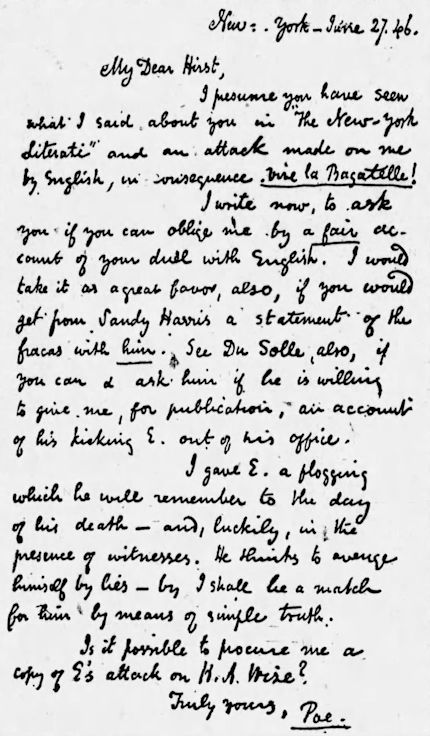
Poe shared with Hirst the antipathy to English, and in one of the letters to Hirst, dated June 27, 1846, he refers to attacks. After asking Hirst for an account of his duel with English and details of the troubles of DuSolle and Sandy Harris with English, he continues:
I gave E. a flogging which he will remember to the day of his death — and, luckily, in the presence of witnesses. He thinks to avenge himself by lies — but I shall be a match for him by means of simple truth. Is it possible to procure me a copy of attack on H. A. Wise?
Two years later is another letter from Poe to Hirst, regarding the latter's poem of “Endymion.” In it Poe writes:
I am glad to hear that you are getting out of which you must know that think highly — very highly — if I did fall asleep while hearing it read.
I live at Fordham, Westchester County — fourteen miles from the city by railroad. The cars leave from the city hall. Should you have any trouble about finding me, inquire at the office of Home Journal — or Union Magazine.
Two weeks after the death of Poe, Maria Clemm, Poe's mother-in-law, wrote to Hirst, asking him to write a [column 5:] critique of one of Mrs. S. Anna Lewis's compositions, which Poe had intended to do. In her letter she says:
God bless you for doing justice to the memory of my own dear Eddie. You who knew him so well knew what a noble heart he had. And now will you do me a very great favor, me, your old friend. Since this deep affliction I have been staying at the house of Mrs. S. Anna Lewis * * * she was at the death-bed of my darling Virginia. Eddie was very much interested in her writings.
LETTERS TO BE SOLD.
From the same pillow case was drawn out a letter written by Poe to T. W. White, who was editor of the Southern Literary Messenger. The superscription and a few lines at the beginning are wanting, but it is a fine letter in regard to his tale, “Berenice.” In it he defended himself for the writing of the tale in these words:
A word of two in relation to “Berenice.” Your opinion of it is very just. The subject is by far too sending it to you especially as a specimen of my capabilities. The Tale originated in a bet that I could produce nothing effective on a subject so singular provided I treated it seriously. * * * You may say all this is in bad taste. I have my doubts about it. To be appreciated you must be read, and these things are invariably sought after with avidity. * * * Such articles as the “Ms. found in a Mad-house” and the “Monos and Diamonos” of the “London New Monthly” — the “Confessions of an Opium Eater” and the “Man in the of Blackwood. The first two were written by no less a man than Bulwer — the “Confessions” universally attributed to Coleridge — though unjustly. Thus the first men in [word obliterated] have not thought writings of this nature unworthy of their talents. * * *
In respect to Berenice individually I allow that it approaches the very verge of bad taste but I will not sin quite so egregiously again.
None of the letters in this find has been printed in the “Life and Letters of Edgar Allan Poe.” But of greater importance than the letters are the Poe manuscripts, which Poe seems to have given to Hirst, and which are written in his beautiful handwriting on single sheets pasted together to form one long sheet, according to his usual custom. The letters and manuscripts are now to come into the market, and form the most important items in a sale which will be held in New York this month. In the George D. Smith sale last month a Poe letter in which he writes about “The Murders in the Rue Morgue” brought $450. Poe manuscripts, especially of his famous poems, seldom came into the market, but their value can be estimated only in four figures. In the coming sale the longest of the Poe manuscripts is that of his essay “About Critics and Criticism,” written on Poe's favorite narrow slips of blue paper and pasted together in a roll about 150 inches long. The autograph of Poe is written beneath the caption. This is a piece of Poe's own criticism, and while the work treats principally of the respective writings Percy Whipple and William A. Jones there are frequent references to the writings of other authors of more enduring fame than these two, mentioning “Jane Eyre,” Emerson, Tennyson. Carlyle, Macaulay, Southey, Byron and others.
ORIGINAL MANUSCRIPTS.
The original autograph manuscript of “Eulalie.” three stanzas in Poe's handwriting on a single sheet, was found in the same pillow case. With it was one of the choicest Poe manuscripts, the existence of which has heretofore been unknown — that of “Annabel Lee,” signed by Poe below the caption. This consists of six stanzas, written on two quarto pages and pasted together in the usual fashion to one long sheet. One of the choicest of Poe's poetical compositions, and in perfect state, its appearance after the lapse of many years will give the Poe collectors a thrill.
It is one of the curiosities of literature that a manuscript of Poe's of sixty-four lines, written for publication, and in answer to a charge by Hirst that Poe had plagiarized Keats's “Endymion” in his “Ulalume” was among the papers of Edmund Clarence Stedman and was sold in the New York auction room in 1911 for $365. The same manuscript again came into the auction room in 1915 and brought $175. These prices, however, do not indicate a falling off in interest among Poe collectors, and the bringing out of this new material is likely to cause a sensation among the admirers of Poe's work. That the charge caused no estrangement between the Philadelphia poet and Poe is evident from the letters found in this unusual safe deposit vault.
∞∞∞∞∞∞∞
Notes:
Most of the letters discovered were from lesser figures than Poe or Longfellow and according to T. O. Mabbott these are now in the NYPL.
∞∞∞∞∞∞∞
[S:0 - KCS, 1921] - Edgar Allan Poe Society of Baltimore - Bookshelf - Pillow Case Held A Literary Treasure (George H. Sargent)